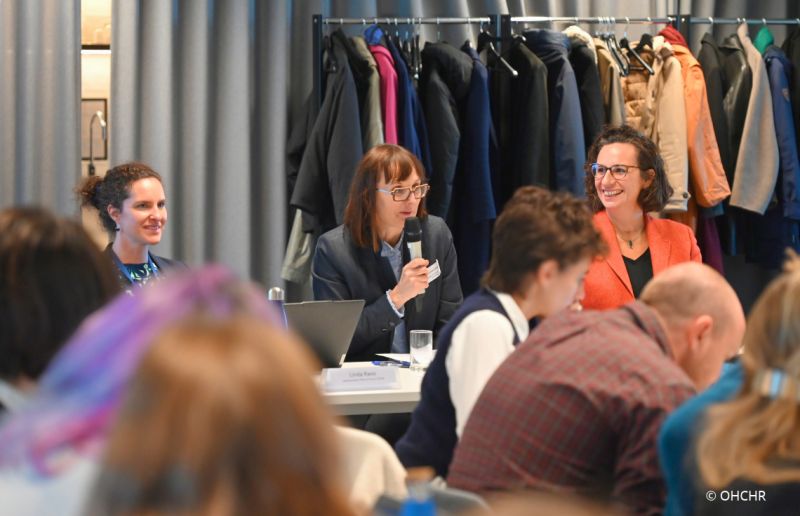
The GNCHR at an expert meeting in Brussels on the implementation of the Screening Regulation

The Greek National Commission for Human Rights (GNCHR) participated in the expert meeting “The Screening Regulation in Practice: Sharing Experiences and Strengthening Cooperation for Human Rights-Based Implementation”, co-organised in Brussels by the European Network of National Human Rights Institutions (ENNHRI) and the Office of the United Nations High Commissioner for Human Rights, Regional Office for Europe.
The GNCHR was represented by the Human Rights Officer (Legal), Mr. Ilias Tsampardoukas.
The meeting brought together representatives of EU Member States, EU and UN bodies and agencies, National Human Rights Institutions and civil society organisations. Discussions focused on the conditions necessary to ensure that Regulation (EU) 2024/1356 is implemented in full compliance with fundamental rights. Attention was given to the early identification of persons in vulnerable situations and their effective access to appropriate protection and safeguards. Participants emphasised that the identification of vulnerabilities can lead to protection in practice only when accompanied by appropriate facilities, adequate expertise, and prompt and effective referral procedures.
Particular emphasis was placed on the role of independent monitoring mechanisms in documenting potential violations, identifying gaps in law, policy and practice, strengthening accountability, and supporting corrective action. To perform their mandate effectively, these mechanisms must enjoy institutional and operational independence, have adequate resources, and be granted meaningful access to locations, procedures and information.
In his intervention, GNCHR’s Human Rights Oficer, Ilias Tsampardoukas, placed particular emphasis on Article 10 of the Screening Regulation, which encourages a collective framework for monitoring compliance with fundamental rights through the involvement of, and use of the expertise of, the institutions and bodies referred to therein. He stressed that the effectiveness of such a framework requires the establishment of stable and transparent terms of cooperation.
In this context, he identified as key conditions the clear delineation of the respective roles, recognition of the complementarity of different institutional mandates, meaningful use of the knowledge and experience of civil society actors, the exchange of expertise and methodological alignment, transparency regarding the methodology, findings and recommendations, and the establishment of effective procedures for referral to the competent authorities, feedback and follow-up on findings.
As a relevant example of collaborative practice, he presented the experience of the GNCHR Recording Mechanism of Incidents of Informal Forced Returns, which is based on cooperation between the GNCHR, civil society organisations and UNHCR in Greece. This model neither replaces civil society organisations and UNHCR’s work nor absorbs their respective activities. Instead, it combines the institutional oversight of a National Human Rights Institution, the field access and operational experience of civil society organisations, and the technical expertise and support of international organisations. In this way, it facilitates the collection of reliable information, the identification of recurring patterns, and their translation into evidence-based findings that can inform national and international institutional actors and processes.
Photo Credits: © OHCHR